Stone Countertops
The use of stone in the construction industry has long been considered. Slab stone processing is one of the newest methods of stone preparation. One of the main applications of stone slabs is in the construction of kitchen countertops, cabinet surfaces, and kitchen islands (stone islands).
One of the most challenging choices when redesigning a kitchen is selecting and purchasing the right countertop. Due to its wide variety of colors and designs, high durability, and excellent resistance, kitchen countertop stone can be one of the best options for your kitchen space.


Table of Contents
Types of Kitchen Countertops & Their Materials
Kitchen countertops and islands can be made from a variety of materials, including MDF panels with melamine or laminate finishes, engineered stones such as Corian, quartz, and marble sheets, as well as natural stones such as crystal marble stone, granite, and marble. Each of these materials offers different levels of resistance to moisture, heat, scratches, and varying aesthetic finishes. The final choice should be based on the level of use, budget, interior design style, and the desired level of durability.
1/ MDF Countertop
MDF panels are economical and come in various colors and designs. However, if the MDF coating is damaged, if the PVC edging and sealing are not properly applied, or if it eventually loses its effectiveness, moisture may seep into the core, causing damage.
2/ Corian Countertop
Corian is a seamless, engineered material made from acrylic resins and mineral materials. It features a non-porous, uniform surface with virtually invisible seams and allows for the creation of curved and continuous forms. These sheets offer a long service life; however, they have moderate resistance to scratches, and their surface may lose some of its original luster over time. Fortunately, they can be sanded and refinished. Their advantages include a wide range of colors, good compressive strength, and completely uniform, seamless joints. On the other hand, a higher price compared to some other options is considered one of their disadvantages.
3/ Quartz Countertop
This stone, known as engineered quartz stone, is composed of approximately 93% natural quartz particles and specialized resins, creating an extremely hard, non-porous, and stain-resistant surface for kitchen countertops. Compared to Corian, it offers greater resistance to scratches, impacts, and heat, while providing durability comparable to or even greater than natural stones such as granite. Its price is generally higher than Corian and MDF, but compared to some high-quality natural stones, it can be a more cost-effective option for high-traffic kitchen spaces.


4/ Natural Stone Countertop
Granite Stone Countertop
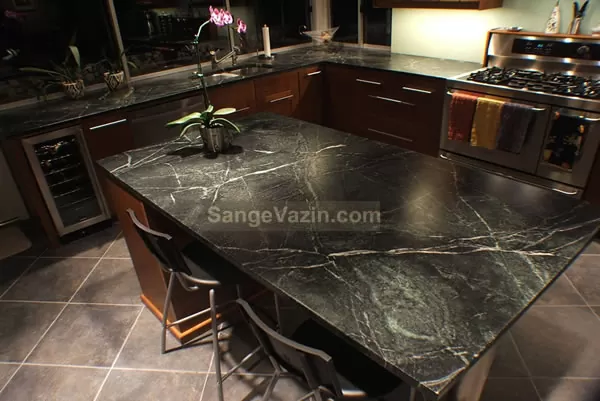
As a type of igneous stone, it possesses high strength and excellent resistance to abrasion, bending, staining, heat, and scratching. The water and oil absorption rates in most varieties are low, offering a uniform and beautiful surface with minimal color and vein variation. This stone features a fine to medium grain texture and is available in various colors, ranging from green to gray and black. The price for granite countertops is relatively affordable, making it a cost-effective choice for luxury and modern kitchens.
Crystal Marble Stone Countertop
Crystal marble stone is a more durable stone than marble, featuring a white, crystalline texture with gray veining that creates a bright and glossy appearance. This stone is suitable for countertop applications because, in addition to its aesthetic appeal, it offers adequate resistance to stains and moisture, making it a practical choice for kitchens.
Onyx Stone Countertop
Onyx is a metamorphic stone composed of transparent crystals that allow light to pass through it (backlit). It is available in colors such as white, cream, blue, light green, and brown. Typically high in value, this stone is used in luxury buildings and religious sites due to its aesthetic brilliance and natural energy. When used for tabletops or kitchen countertops, proper maintenance must be observed to preserve its beauty and durability.
| Material | Price | Durability | Composition & Material | Scratch Resistance | Maintenance & Cleaning | Color & Pattern Variety |
| Natural stone (Granite/Onyx/Crystal marble) | Medium to high (depending on type and color) | Very high | Coarse-grained or crystalline natural stone | High (Granite), Medium (Crystal marble), Medium to Low (Onyx) | Requires sealing and care; repairable. | Limited but natural and beautiful. |
| Corian | Medium to high | Medium | Acrylic resin + mineral materials | Medium | Easy; repairable via polishing. | Very high; diverse colors. |
| Quartz | High | Very high | Approximately 90-95% quartz particles + resin | High | Easy; stain and water-resistant. | Diverse but artificial; patterns resembling natural stone. |
| MDF | Low | Medium | Compressed wood particles + coating. | Low to medium. | Easy, but sensitive to water and heat. | High color variety and custom designs. |
If you are looking for unique beauty, a special aesthetic, and high durability for your countertops, the best choice is to utilize the unparalleled design of natural stone. This is because the colors and patterns of natural stones are irreplicable, and no type of Corian or HPL can match their appearance in your kitchen. This is particularly important given that modern kitchens feature open layouts, where countertops are highly visible on islands and peninsulas. Consequently, this method of stone processing has gained significant attention in the global market, becoming one of the key capacities for stone export.
Key Points In Selecting A Stone Countertop
One of the essential points in choosing a countertop is the type of stone. It is important to choose a stone with low water absorption to prevent cracking.
Among the available options, granite stones are the top priority, followed by white and light-colored crystal marble stones, such as Azna crystal marble, Neyriz crystal marble, and Aligudarz crystal marble, as well as certain types of light-colored marble, which can also be suitable options for kitchen countertop stone.
However, we recommend that you avoid using onyx for kitchen countertops.
Color & Design Variety in Natural Stone Countertops
Natural stone kitchen countertops are available in a wide range of colors (dark and light) and patterns (wavy, veined, cloudy, or uniform). Depending on your kitchen’s interior design style, you can choose from various types of crystal marble, granite, or onyx.
Importance of Proper Support in Kitchen Countertop Installation
A metal support structure (steel framing) is required to increase the durability and strength of a stone kitchen countertop. This helps prevent the stone from becoming vulnerable to damage and developing cracks over time.
Kitchen Countertop Stone Care and Maintenance
If you choose onyx for your kitchen countertop, please note that it requires special care and maintenance. Onyx is prone to staining and scratching and will become dull over time. Applying a nano coating to the stone surface can help improve its resistance. However, we recommend avoiding onyx for kitchen countertops whenever possible and considering more durable alternatives.
Granite has very high resistance to scratches, heat, and moisture; however, to maintain surface quality, periodic sealing and prompt cleaning of stains are recommended. Using mild detergents helps increase its lifespan and preserve its luster.
Crystal marble offers adequate resistance to moisture and stains, but it should not be cleaned with harsh or acidic detergents. In the event of spills involving lemon juice, vinegar, or colored liquids, the surface must be cleaned immediately to prevent staining.
View a Variety of Countertop Stone Samples
In the gallery below, you can view a variety of images of different types of stone countertops and make the best choice according to your taste and needs.


Advantages of Stone Countertop
- Free from harmful chemicals
- High strength and durability
- Heat resistant
- Natural patterns
- Recyclable and environmentally friendly
It should be noted that the granite countertop, in addition to the mentioned features, is very resistant to scratches and acidic materials compared to other stones.
Disadvantages of Stone Countertop
One of the disadvantages of stone countertops is the lack of durability in marble-based surfaces and their need for careful maintenance against acidic substances.
- Onyx is the most sensitive type of stone; it is easily scratched, stained, and becomes dull.
- Marble requires protection against acidic substances.
- Installation and sub-structure costs for natural stones are higher than those for ready-made MDF or Corian surfaces.
- High weight and the requirement for specialized transportation.
Different Types of Stone Countertop Edge Profiles
Stone countertop edge profiles can be executed in various styles, ranging from simple to multi-tiered, as shown in the images below. Terminology regarding edge profiles for countertops, tables, or islands includes the following, which can be applied individually or in combination:
- Cove edge (reverse bullnose edge)
- Bullnose edge (reverse cove edge)
- Full bullnose edge ( semi-circular edge)
- Dupont edge (straight and vertical)


Read the following article:
Stone Countertop Ordering & Measuring
The process of installing these stones involves expert technicians precisely measuring the required dimensions using high-precision tools and machines. Measurements can also be provided to Vazin Stone by other professionals.
Factors Affecting the Price of Kitchen Countertops
In general, countertops are made from slab stones. To view slab stone prices, simply select your desired stone, and the price will be displayed on the website (slab stone).
- Stone type (Marble – Crystal marble – Onyx – Granite)
- One-piece dimensions
- Thickness of countertop
- Steel framing under the countertop
- Laser cutting and edge profiling (double step edge, triple step edge, modern)
- Transportation and installation
After all the above items are specified, the price will be announced and delivered on time.
FAQs about Stone Countertops
Which stone is suitable for countertops?
The best stone for kitchen countertops depends on the level of usage, budget, and the design style of the kitchen. Among natural stones, granite is considered the best option due to its high resistance to scratches, heat, moisture, and acidic substances. Crystal marble stone is also a suitable choice for light-colored cabinets, creating a modern aesthetic. If unique and luxurious beauty is your priority, onyx is also an option, though it requires more careful maintenance.
How is the price of kitchen countertops calculated?
The price of kitchen countertops depends on various factors, including the type of stone (granite, crystal, marble, onyx, or marble), the dimensions and thickness of the slab, the amount of cutting and edge profiling, sink and hob cutouts, metal sub-structures, and shipping and installation costs. Therefore, the final price is determined once the project dimensions and specific details are finalized.
Are natural stones better for countertops than Corian and Quartz?
Each material has its own specific advantages, but natural stone is considered an excellent choice in terms of aesthetics, durability, and long-term value. The patterns and veining of every piece of natural stone are completely unique, with no two pieces being identical. In contrast, Corian and Quartz offer a wider variety of colors and are easier to maintain. If you are looking for a luxurious kitchen with a natural and enduring appearance, natural stone will be the more suitable option.
Do stone countertops require special maintenance?
Yes, but the level of maintenance depends on the type of stone. Granite requires very little maintenance; periodic sealing and the use of mild cleaners are sufficient to maintain its quality. Crystal marble stone is also easy to maintain, but acidic substances should not be left on the surface for extended periods. Onyx is more sensitive than other stones and requires more care to prevent staining and scratching.
What is the ideal thickness for kitchen countertops?
The most common thicknesses for kitchen countertops are 2 cm and 3 cm. 2 cm slabs can achieve a thicker appearance through appropriate sub-structuring and edge profiling, making them suitable for most residential projects. 3 cm slabs offer greater strength and are a better option for large islands, high-traffic counters, and luxury projects. Choosing the appropriate thickness depends on the type of stone, the dimensions of the slab, and the overall countertop design.